How to Start an IPTV Business: A Complete Step-by-Step Guide
 Anahit Aleksanyan11 min read
Running an IPTV business isn’t just about streaming video. It’s about managing, delivering, and monetizing content in a way that works for your users, whether you’re serving everyday viewers or providing the technology that helps other businesses launch their own IPTV services.
In this business, there are a few roles you can play: you might be an IPTV provider, running the full service yourself; a reseller, selling access to an existing platform; or a platform owner, building the system and tools for others to operate their own service. Each role has its own opportunities and challenges, and understanding the differences will help you choose the right path for your business.
Let’s dive deeper into these roles, explore the different business and revenue models, and see what it really takes to start, grow, and scale a successful IPTV business.
What Is an IPTV Business?
An IPTV business is a business that delivers TV content over the internet.
Unlike cable or satellite TV, IPTV uses an Internet Protocol (IP) network. This means viewers can watch live TV, shows, and movies over an internet connection instead of traditional cable or satellite service.
When we talk about the IPTV business, we mean the delivery, management, and monetization of TV content over IP networks. This includes services for everyday users as well as solutions built for businesses and enterprises.
An IPTV business can work in different ways. You may run your own TV service for viewers, or you may provide the technology that helps other companies launch and manage their own IPTV platforms. What connects all these models is the use of the internet to deliver live TV, video on demand, and interactive content with more flexibility and control than traditional TV systems.
In the IPTV business, these roles are often mixed up. Understanding the difference helps you choose the right model for your needs.
Let’s explore the difference between IPTV providers, resellers, and platform owners.
An IPTV provider delivers TV services directly to users or business clients.
As a provider, you:
-
Deliver live and on-demand content
-
Manage the streaming system
-
Take care of service quality and support
When you work with a provider, they control the full TV service from start to finish.
An IPTV reseller sells access to an existing IPTV service.
As a reseller, you:
-
Do not own the platform or servers
-
Depend on another company for quality and stability
-
Focus mainly on sales, not technology
This model gives you less control over the service and fewer options for customization.
As a platform owner, you:
-
Build the IPTV system and apps
-
Provide tools to manage content and users
-
Support branding, integrations, and analytics
Instead of selling TV channels, platform owners help you launch and run your own IPTV or OTT service. This model works well for businesses that need control, flexibility, and long-term growth.
IPTV Business Models
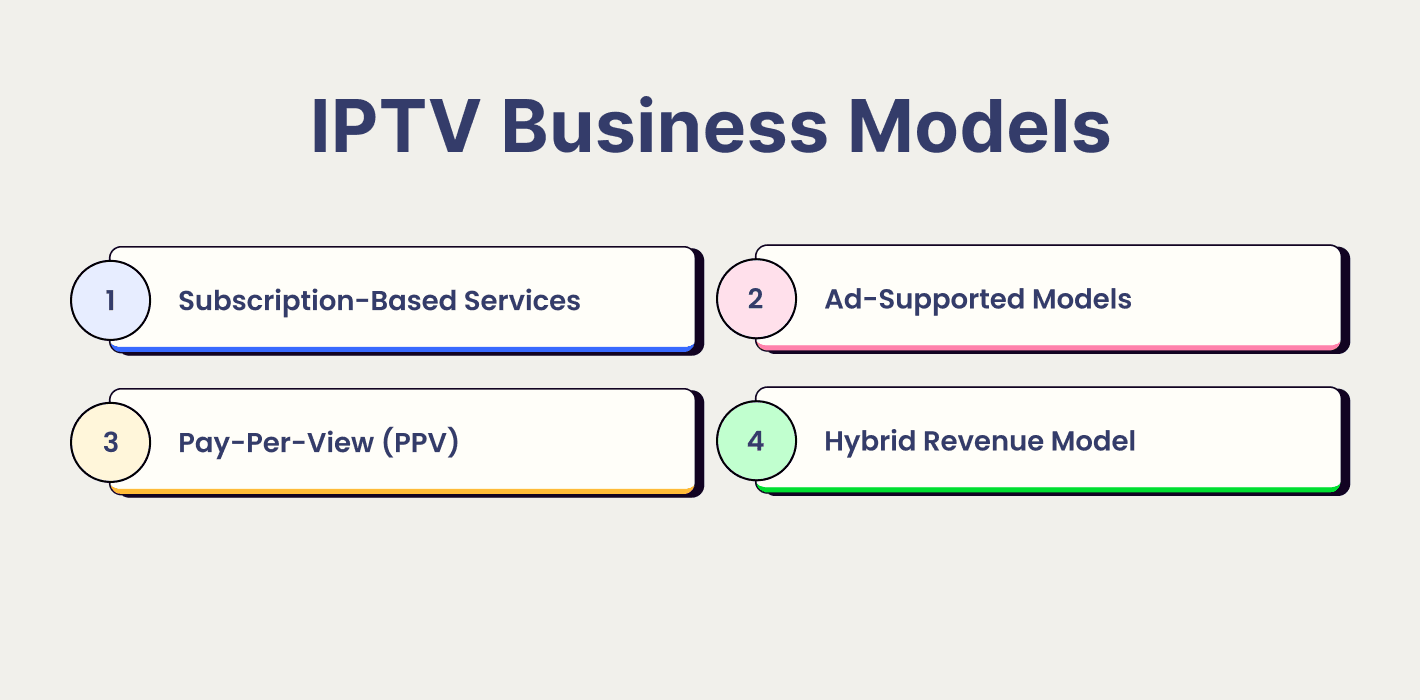
IPTV businesses use different ways to earn revenue. In many cases, companies combine more than one model to create a stable and flexible business.
These are the most common IPTV revenue models.
1. Subscription-Based Services
In a subscription model, users pay a fixed fee to access your IPTV service.
You:
-
Charge monthly or yearly subscriptions
-
Offer access to live TV, on-demand content, or both
-
Focus on long-term customer relationships
This model gives you predictable revenue and works well for services that offer regular content updates.
2. Pay-Per-View (PPV)
With pay-per-view, users pay only for specific content.
You:
-
Charge users for single events or programs
-
Commonly use this model for sports, concerts, or special events
-
Do not require a long-term subscription
PPV works well when you offer high-value or exclusive content.
3. Ad-Supported Models
In an ad-supported model, users can watch content for free, while you earn revenue from advertising.
You:
-
Show ads before or during content
-
Focus on audience size and engagement
-
Offer free access to attract more viewers
This model is often used for free TV channels or on-demand libraries.
4. Hybrid Revenue Model
Many IPTV businesses use a hybrid approach that combines several revenue streams.
For example, you might:
-
Offer subscriptions with ads
-
Add pay-per-view events on top of a subscription
-
Provide a free, ad-supported tier and a paid, ad-free option
This approach gives you more flexibility and helps you reach different types of users.
What You Need to Start an IPTV Business
Starting an IPTV business is not only about streaming TV content. You need the right mix of technology, planning, and business structure to build a service that can grow over time.
Research and Analyze the Market
Before you start, it’s important to understand your audience and competitors. Ask yourself:
-
Who are my users?
-
What types of content do they want?
-
Which IPTV models are popular in my market?
Doing proper market research helps you choose the right IPTV model, target the right audience, and plan your content and pricing strategy.
Choose the Right IPTV Model
There are several IPTV streaming models, each with a different way of delivering content. While it’s technically possible to use all of them at once, we don’t recommend it because it requires a lot of time, money, and effort.
Instead, focus on the model that your users prefer and that fits your market. Here are the main IPTV options to consider:
-
Video on Demand (VOD): Users can watch content anytime during their subscription.
-
Near Video on Demand (NVOD): Pay-per-view content is broadcast for a limited period and changes regularly.
-
TV on Demand: Users can access channels or programs, such as news, whenever they want.
-
Live Broadcast: Streams video in real time. Users cannot rewind or watch it again later.
-
Time-Shifted TV: Records previously aired programs so users can rewatch them.
All of these models work in a similar way, but they require different setups and software tools.
Choose a Content Strategy
You also need a clear content plan. Which means:
-
Deciding what type of content you will offer
-
Making sure content usage follows local regulations
-
Organizing channels, VOD, and metadata properly
Make sure to organize your content with different tags, like genre or type. This makes it easier to manage and helps viewers quickly find the videos they want.
Monetization and Payments
You also need to plan how your business will make money. Some common options include:
-
Subscription-based services (monthly or yearly)
-
Pay-per-view content
-
Advertising-supported streaming
-
A hybrid model that combines multiple revenue streams
Make sure your payment system is secure and easy to use, so users can subscribe or purchase content without any issues.
Content Delivery and Performance
To keep your viewers happy, you need to deliver content smoothly. This means:
-
Using a reliable server or cloud hosting setup
-
Optimizing your Content Delivery Network (CDN) to reduce buffering and latency
-
Ensuring streams work well on all devices, from smart TVs to mobile apps
Good performance and reliable delivery keep users engaged and reduce support problems.
Choose Multi-Player for your IPTV Business
When you start an IPTV business, one of the biggest challenges is making sure your service works smoothly on all devices. Smart TVs, TV boxes, and other platforms all require different video players, which can be time-consuming and costly to build and maintain.
This is where Multi-Player comes in. It gives you ready-to-use, fully optimized video players that work across Smart TVs and TV boxes from a single platform. You don’t need to develop separate players for each device; one solution covers them all.
Multi-Player helps you deliver a reliable and consistent experience to your users:
-
Stream across multiple devices: One platform streams smoothly to all Smart TVs and TV boxes.
-
Smooth, stable playback: Adaptive streaming ensures fast start times, minimal buffering, and consistent performance.
-
Consistent user interface: Your viewers enjoy the same intuitive interface no matter which device they use.
-
Automatic updates and maintenance: Performance improvements, bug fixes, and platform updates happen automatically.
-
Modern, user-friendly design: The interface is simple and easy to use, even for non-technical users.
-
Ongoing enhancements: New features, tools, and optimizations are added regularly so your service stays current.
Using Multi-Player is the smarter way to scale your IPTV business. It saves time, reduces technical complexity, and ensures your service is reliable, future-ready, and enjoyable for all users, no matter what device they choose.
Supported Devices and Platforms You Must Cover
If you want your IPTV business to succeed, you need to make sure your service works on all the devices your viewers use. The more platforms you support, the more people can enjoy your content without any frustration, and that keeps them coming back.
Smart TVs
Most of your viewers will want to watch on their TVs, so it’s important to cover major Smart TV platforms like Samsung Tizen, LG webOS, and Android TV. Pay attention to things like smooth navigation with the remote, screen resolution, and overall performance. You want your users to have a seamless experience every time they switch on your service.
TV Boxes and Streaming Devices
Some users prefer set-top boxes such as Apple TV, Roku, Nvidia Shield, Amazon Fire TV, or Android TV. These devices are popular because they give viewers more flexibility and a better viewing experience. Make sure your IPTV service runs well on these, too, you don’t want anyone struggling with buffering or glitches.
Mobile Devices
Your audience is on the go, so don’t forget iOS and Android smartphones and tablets. Make sure your videos adjust to different screen sizes, stream smoothly, and, if possible, allow offline viewing. A good mobile experience can really set your service apart.
Desktop and Web
Some people still watch on laptops or desktops, so your service should support Windows and macOS, as well as browsers like Chrome, Edge, and Safari. Smooth playback and secure streaming are key here.
Cross-Platform Consistency
No matter what device your viewers use, the experience should feel the same. The interface, navigation, and playback should be familiar and easy to use, whether they’re on a TV, a mobile device, or a laptop. You want them to feel at home on your platform.
How to Scale an IPTV Business Successfully
As your IPTV business grows, it’s important to plan for scaling your service so it can handle more users and content without losing performance. This means increasing capacity, upgrading your infrastructure, and improving operations to keep everything running smoothly.
Start by expanding your server capacity and bandwidth to support more subscribers. As your user base grows, you may need to add resources to your Virtual Private Server (VPS) or upgrade your server hardware. These steps help your platform handle multiple streams at the same time without problems like buffering or downtime.
If you want to avoid the hassle of constantly upgrading hardware, a cloud-based IPTV solution can make scaling much easier.
Another key part of scaling is improving your Content Delivery Network (CDN). You can add more nodes in important locations or work with a trusted CDN provider to deliver content faster. This helps reduce delays and ensures smooth streaming for your users, no matter where they are.
Conclusion
Starting and running an IPTV business can seem complex, but with the right planning, tools, and strategy, it’s completely achievable. From choosing the right business model and monetization strategy to ensuring smooth content delivery across all devices, every step matters in building a service that users love and trust.
The key is to combine technology, strategy, and performance to grow your business sustainably. Whether you’re just starting or planning to scale, focusing on these core areas will give your IPTV service a competitive edge and prepare it for long-term success.
Your next step is simple: choose the model that fits your goals, invest in the right tools, and start delivering IPTV the way your audience expects, flexible, smooth, and future-ready.
Frequently Asked Questions
Resources
How to Use IPTV to Watch Live TV, Sports, Movies, and More in
How to Set Up IPTV on a TV Without a Set-Top Box? A Practical Guide
Content Writer
Anahit is a technical content writer and digital marketing specialist who focuses on B2B content about IPTV, multiplatform media, and digital technologies. She creates clear and engaging content about modern media technologies. Her goal is to help readers easily understand complex topics and stay informed about the latest innovations in digital media.